Why a Habit Tracker That Does Not Judge You Actually Works Better
There is a moment most habit tracker users know well. You open the app after missing a few days and there it is: a row of red Xs, a broken streak counter, a grid that looks like a report card from a bad week at school.
Your stomach tightens. You feel a flush of shame. And then, more often than not, you close the app and do not open it again for days — or ever.
This is not a design flaw. It is the design. Most habit trackers are built on the assumption that guilt is a good motivator. Show people their failures clearly enough and they will try harder. Punish inconsistency visually and people will become consistent.
The research says otherwise.
The Problem With Shame-Based Design
Habit trackers inherited their design language from two places: to-do lists and video games. From to-do lists, they took the checkbox — satisfying to tick, accusatory when empty. From games, they took streaks and loss mechanics — powerful engagement tools that exploit your fear of losing progress.
Together, these create an app that feels great when you are doing well and terrible when you are not. And since nobody does well all the time, the terrible feeling is inevitable.
⚠️ The guilt spiral
Researchers at Carleton University found that people who feel guilt and self-blame after a setback are significantly more likely to procrastinate on the task in the future. Shame does not motivate action — it motivates avoidance. The red Xs in your habit tracker are not pushing you forward. They are teaching your brain that opening the app is an unpleasant experience.
The numbers confirm this. The average habit tracking app has a 60-day retention problem. Most users quit within two months — not because they stopped wanting better habits, but because the tracker became a source of stress rather than support.
What Judgement Looks Like in a Tracker
Judgement in app design is not always obvious. It does not announce itself. But once you start looking for it, you see it everywhere:
- Broken streak counters that reset to zero, erasing weeks of progress over one missed day
- Red or grey marks for days you did not complete a habit, making your history look like a failure log
- Aggressive notifications — "You have not logged your workout today" at 9pm, when you are already in bed
- Completion percentages that drop from 95% to 80% because you had a bad week, framing consistency as something you are losing
- Leaderboards and social sharing that turn personal growth into a competition
Each of these design choices carries an implicit message: you are not doing enough. And that message, repeated daily, wears people down.
The Alternative: Awareness Without Judgement
A non-judgmental tracker replaces the question "did you succeed or fail today?" with a simpler, kinder one: "how long has it been?"
That shift changes everything.
When a tracker shows you that it has been 12 days since you last exercised, that is information. It is not labelled as good or bad. It is not coloured red. It is not accompanied by a disappointed notification. It is simply a fact you can act on — or not.
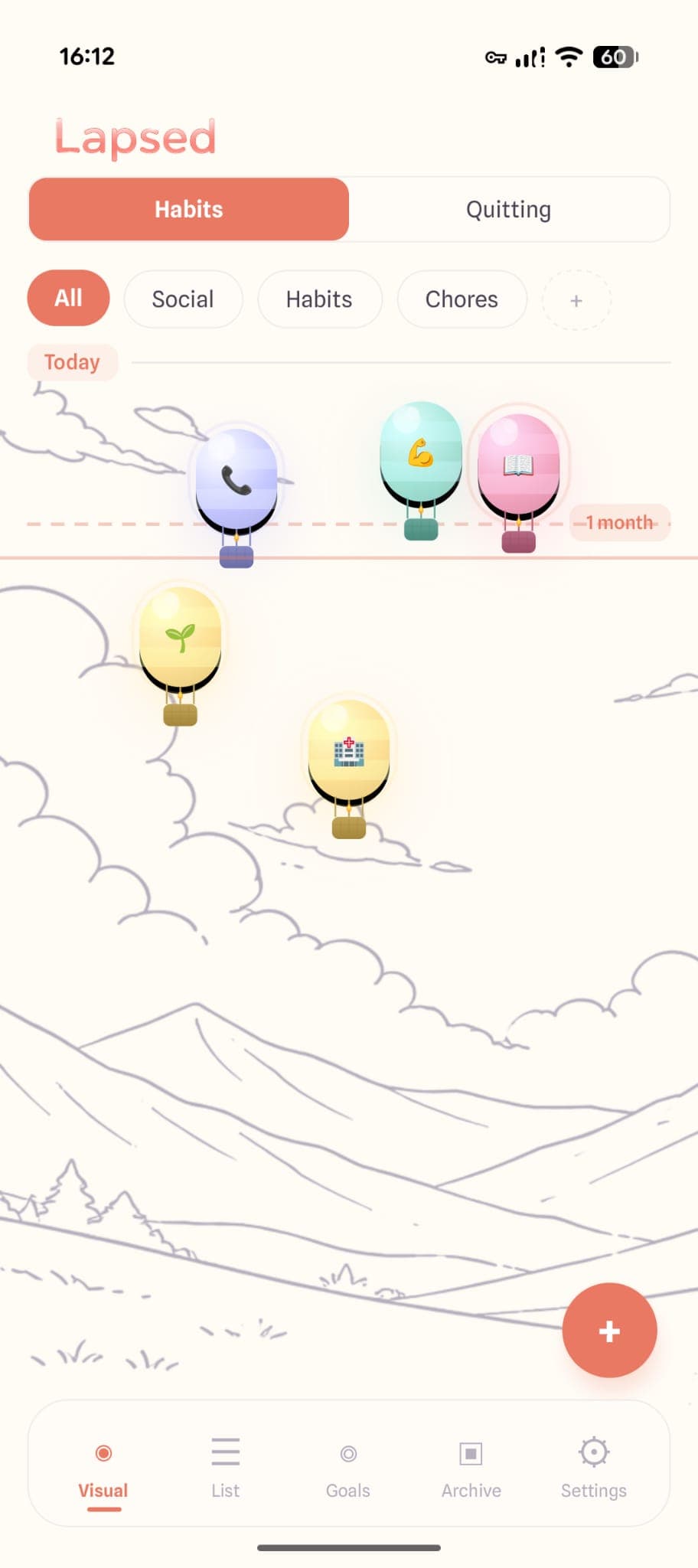
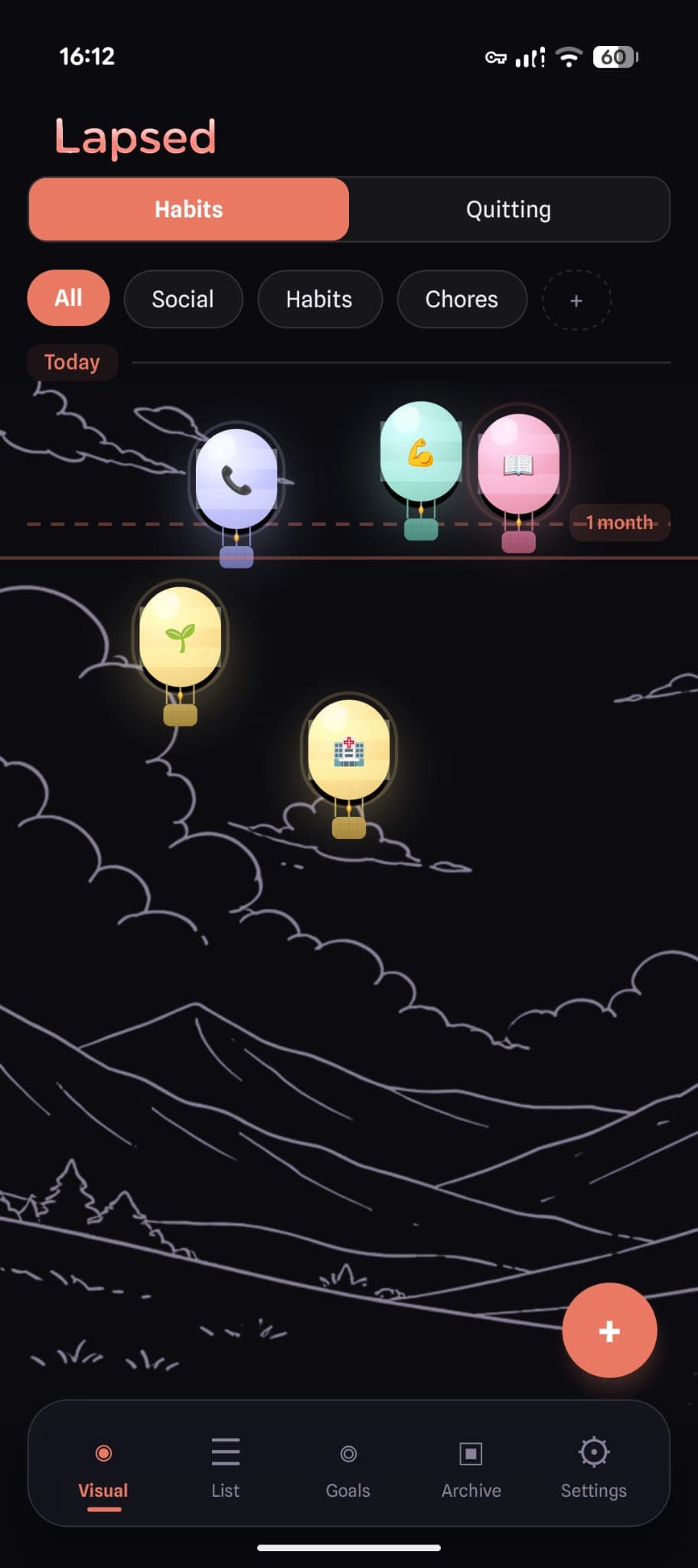
This is the approach Lapsed takes. Your habits float on a visual canvas — dots, balloons, hot air balloons, spaceships, or jellyfish. Recent items sit near today. Older items drift further away. The canvas is the same whether you logged everything yesterday or nothing for a fortnight.
There is no punishment state. No failure mode. The app looks beautiful regardless of your behaviour, because its job is to show you time — not to grade you on it.
Why This Approach Is More Effective
Being kinder is not just nicer. It actually produces better outcomes. Here is why:
Self-compassion drives consistency
Kristin Neff's research shows that self-compassion — treating yourself kindly after setbacks — leads to greater motivation, not less. People who forgive themselves for missing a habit are more likely to resume it than those who punish themselves.
No avoidance spiral
When opening an app feels neutral or pleasant, you open it more often. When it feels punishing, you avoid it. A guilt-free tracker stays in your routine because it never becomes something you dread.
Thresholds beat streaks
A threshold says "aim for roughly every 7 days." A streak says "never miss a single day." Thresholds are realistic. Streaks set you up for inevitable failure. Realistic systems last longer.
Visual over numerical
Seeing a balloon floating higher is gentler than seeing "0 days" in bold red. Both communicate the same information, but the visual version does not trigger shame. Your brain processes it as spatial awareness, not personal failure.
What a Judgement-Free Tracker Feels Like
The daily experience is remarkably different from a traditional habit tracker.
You open the app and see a canvas. Some items are near today — things you have done recently. Others are drifting further away. There is no red or green. No score. No percentage. Just a gentle visual landscape of your habits and how long it has been since each one.
If something has passed its threshold, you can see it — the item has drifted further, perhaps past a threshold line. But the app does not scold you. It does not send you a notification that says "You were supposed to do this 3 days ago." It simply shows you where things stand and lets you decide what to do.
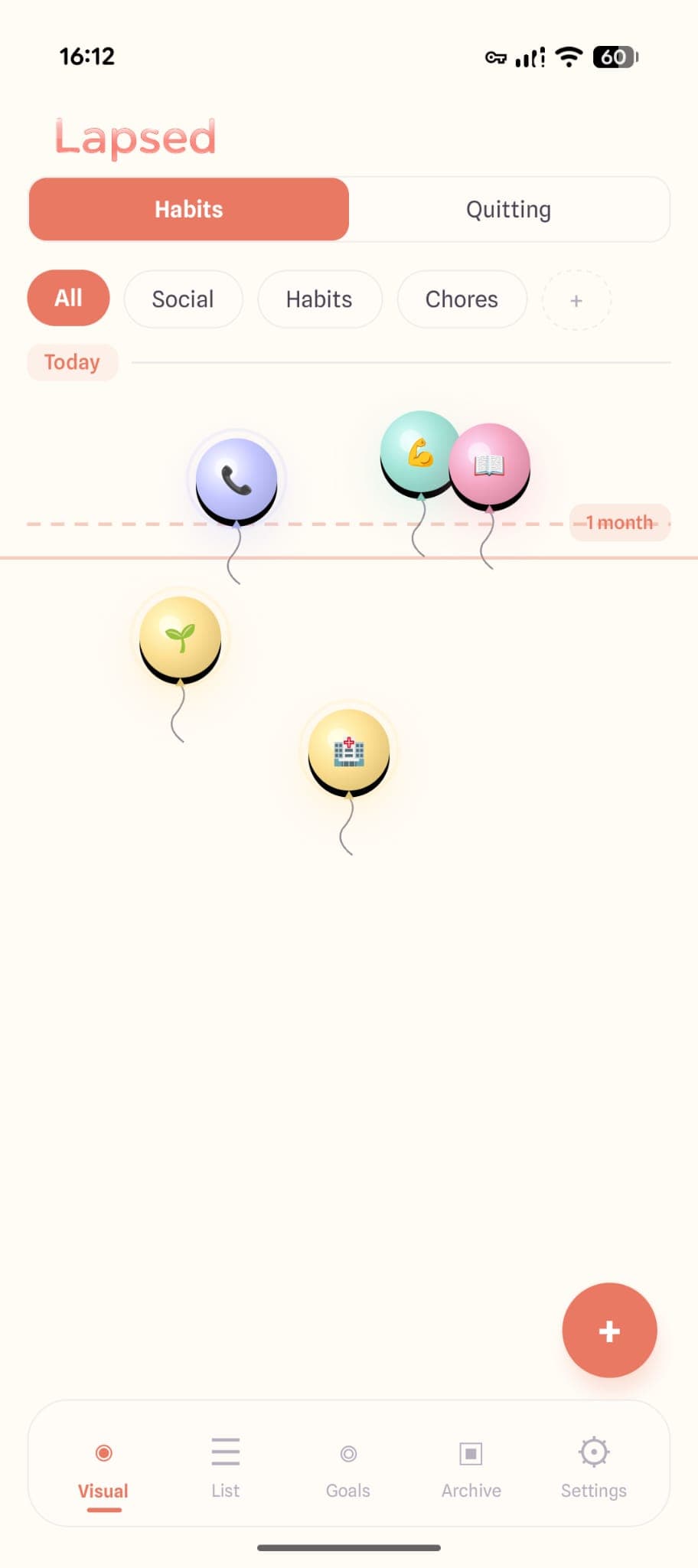
Log something and the item moves back to today. That is it. No fanfare about maintaining a streak. No "great job" badge. Just a calm, matter-of-fact return to the present. The reward is the visual itself — seeing your canvas tidy, your items close to today, your life in a rhythm that feels right to you.
Reframing What Success Looks Like
Traditional trackers define success as perfection: every box ticked, every day accounted for, no gaps in the chain. This sets an impossible standard and guarantees eventual failure.
A non-judgmental tracker redefines success as awareness. You are succeeding whenever you look at your habits and know where you stand. You are succeeding when you notice that something important has drifted and decide to do it today. You are succeeding even when you look at the canvas, see that everything is overdue, and think "I will get to it tomorrow" — because you are still engaged, still aware, still in the game.
✨ Try this shift
Next time you miss a habit, notice your self-talk. If your first thought is "I failed" or "I am bad at this," the tracker is shaping how you think about yourself. A tool that shows you the same information without the moral framing lets you think "it has been a while — I will do it today" instead. Same data, completely different emotional response.
This is not about lowering the bar. It is about building a sustainable relationship with your own goals. People who track with awareness rather than judgement stay with it longer, maintain more consistent habits over time, and — critically — actually enjoy the process.
The Tracker You Deserve
You did not start tracking habits because you wanted another thing in your life to make you feel bad. You started because you wanted to grow, to be more intentional, to build a life that looks the way you want it to look.
The right tool supports that vision without adding shame to the process. It shows you time, shows you patterns, shows you where your attention is going — and trusts you to make good decisions with that information.
Tracking without the guilt trip
Lapsed uses visual canvases and gentle thresholds instead of streaks and shame. See your habits clearly without the judgement.
Read about gentle habit trackers for people with anxiety or explore why a tracker without streaks works better for long-term consistency.
Your habits are not a report card
Five beautiful canvas styles. No red marks. No broken streaks. A tracker that shows you time without judging how you spend it.
Written by Lapsed
The beautiful days since tracker. Track your life visually.
Related Articles

The Best Habit Trackers Without Streaks in 2026: Track Without the Pressure
Tired of streak-based habit trackers that punish you for missing a day? These no-streak habit tracker apps use gentler approaches — visual canvases, thresholds, and flexible logging — so you can track without anxiety.
Gentle Habit Trackers for People With Anxiety: Calm Apps That Help Without Pressure
If habit tracking apps make your anxiety worse, you are not alone. These gentle, calm tracker apps use visual approaches and flexible thresholds instead of guilt and streaks.
Why an Aesthetic Habit Tracker Actually Works Better: Beauty as a Feature
Most habit trackers are ugly and forgettable. An aesthetic tracker with glassmorphism, spatial UI, and calm colours changes your relationship with tracking entirely. Here is why design matters more than features.