Why Streak Counters Make You Quit (And What to Use Instead)
Your streak is at 47 days. You have been consistent for almost seven weeks. Then life happens — you get sick, travel throws off your schedule, or you simply forget. The counter resets to zero. Forty-seven days of effort, gone.
How does that make you feel? For most people, the answer is: bad enough to stop tracking altogether.
This is the streak counter problem. And it is one of the biggest reasons people abandon habit tracking apps.
The Psychology of Streak Failure
Streak counters tap into loss aversion — our tendency to feel losses more strongly than equivalent gains. Building a 47-day streak feels good, but losing it feels devastating. Research shows that loss aversion is roughly twice as powerful as gain motivation, meaning breaking a streak feels twice as bad as maintaining it feels good.
This creates a toxic cycle:
- Build a streak → feel motivated
- Break the streak → feel disproportionate disappointment
- All-or-nothing thinking → "I already ruined it, what is the point?"
- Abandon the app → lose all tracking benefits
⚠️ The abstinence violation effect
Psychologists call it the "abstinence violation effect" — when breaking a self-imposed rule leads to complete abandonment rather than recovery. Streak counters create exactly this dynamic. One missed day does not mean failure, but the zeroed counter says otherwise.
What Streaks Get Wrong
Streaks assume consistency means "every single day, no exceptions." But real life is not like that. Consider these perfectly healthy patterns:
- Exercise 4 times a week — A streak counter marks 3 "missed" days every week
- Call parents every 10 days — A daily streak is meaningless here
- Meditate most mornings — Missing Monday does not erase Tuesday through Sunday
Streaks force an all-or-nothing binary onto behaviours that are naturally variable. They punish realistic consistency in favour of impossible perfection.
The Alternative: Threshold-Based Tracking
What if instead of counting consecutive days, your tracker showed you how long it has been — and let you set your own definition of "too long"?
This is threshold-based tracking, and it is fundamentally different from streaks:
| Streak Counter | Threshold Tracker | |---|---| | Resets to zero on a miss | Never resets — just shows elapsed time | | Binary: on-streak or off | Gradient: close to today or drifting | | Punishes one bad day | Accommodates natural variation | | Creates anxiety | Creates awareness | | All-or-nothing | "Keep it reasonable" |
A threshold is a line you set: "I want to exercise at least every 4 days." If you are at 3 days, you are fine. At 5 days, you are drifting. At 8 days, it is been a while. There is no catastrophic reset. No zero. Just a gentle signal that something needs attention.
How Lapsed Replaces Streaks
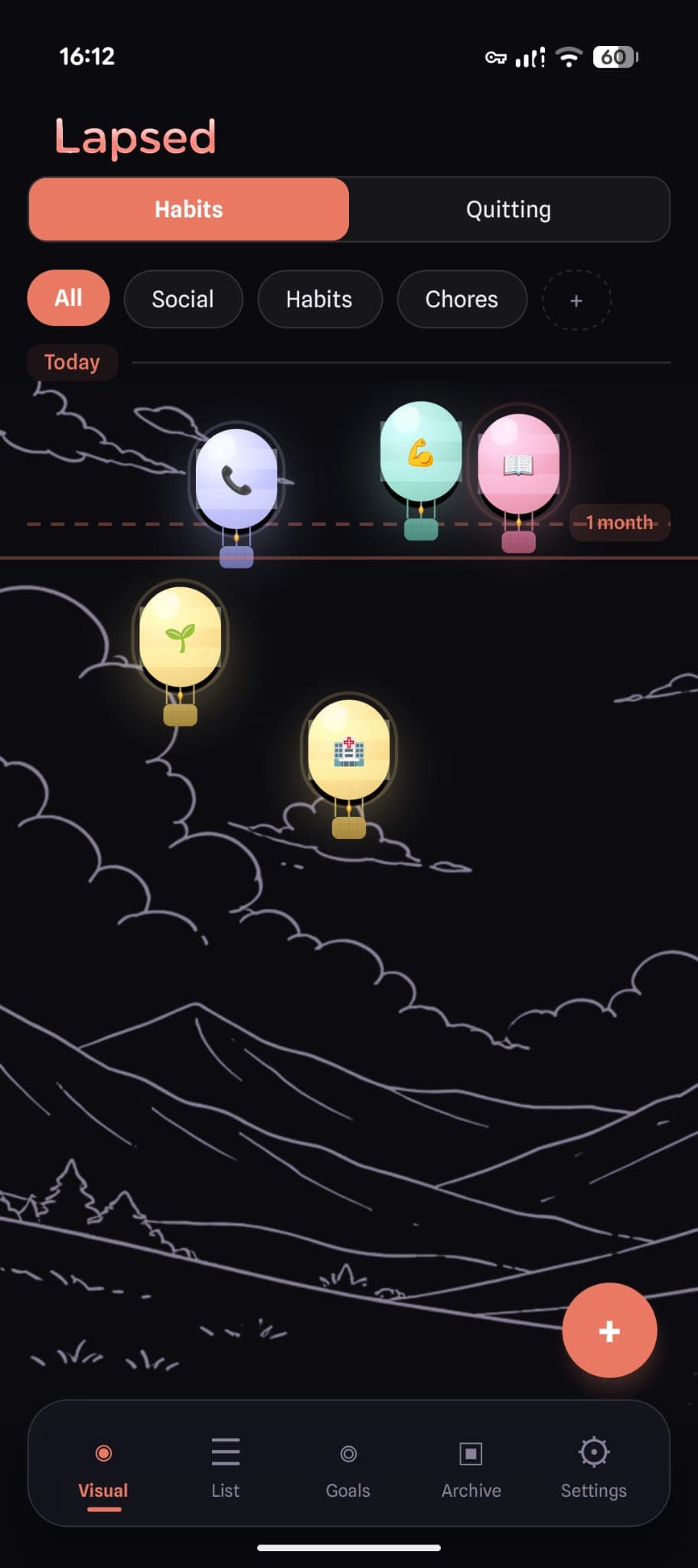
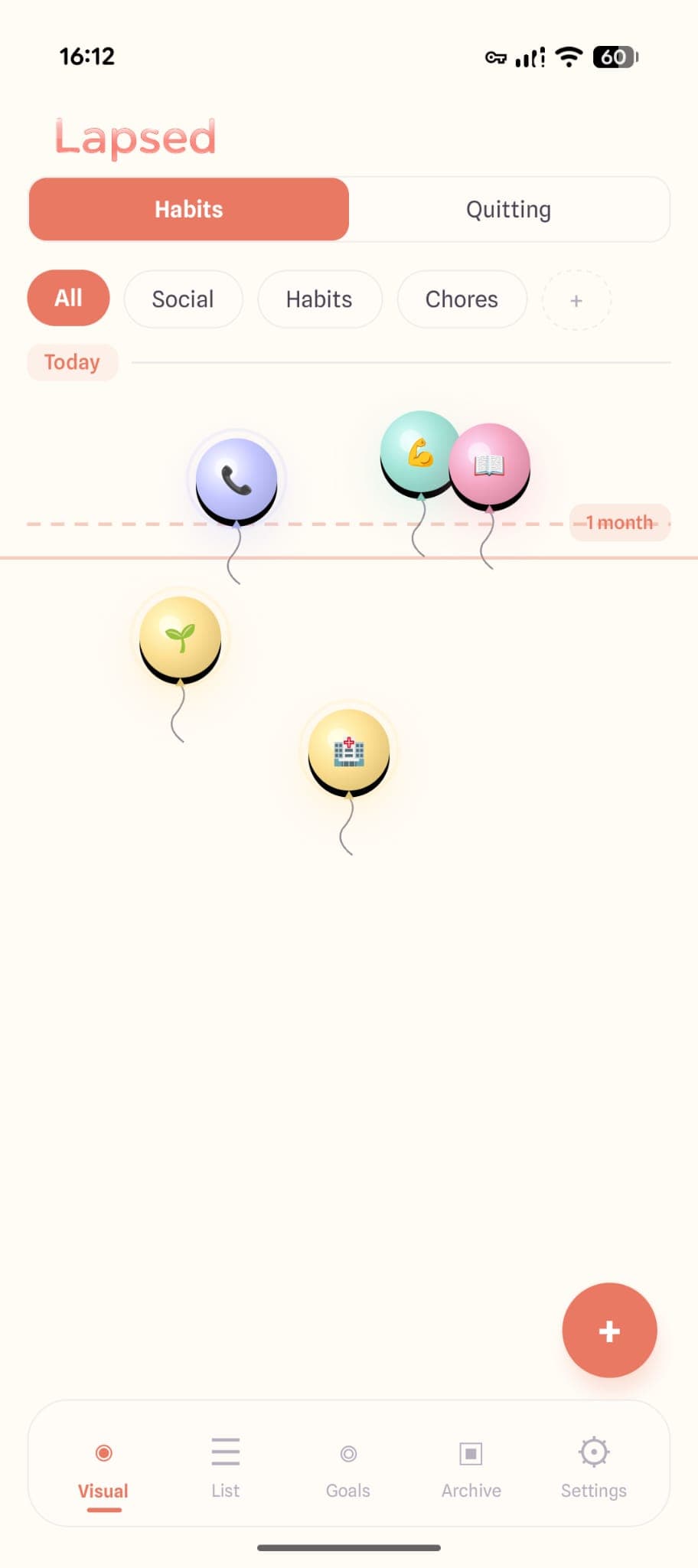
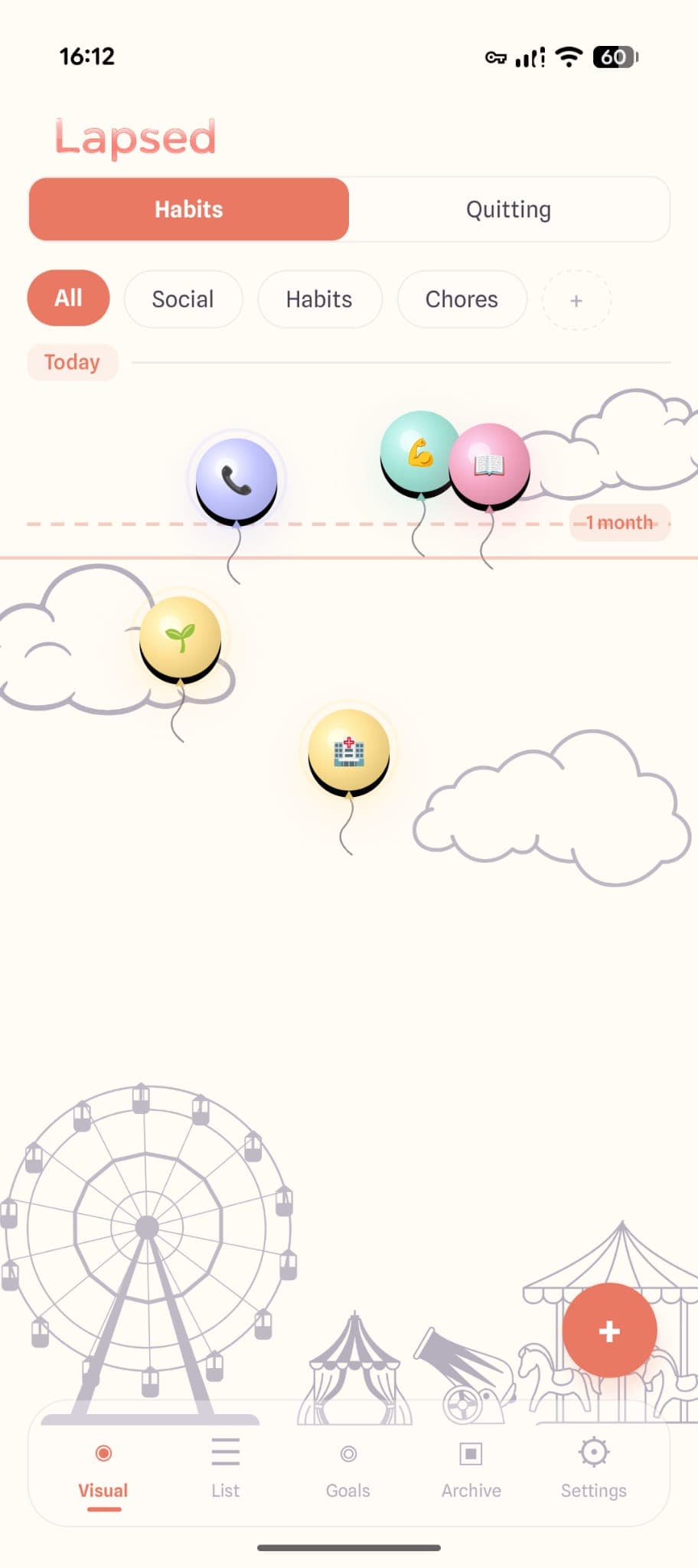
Lapsed is a visual day counter that uses thresholds instead of streaks. Each item you track is a dot, balloon, hot air balloon, spaceship, or jellyfish on a canvas. A threshold line marks your target interval. Items drift past the line the longer it has been.
The psychological difference is profound:
- No zero. You never see a counter reset. Your item just drifts further from today, and you bring it back when you act.
- No failure state. Being past the threshold is not failure — it is information. You see it, you act on it, the item snaps back.
- Forgiveness built in. Had a rough week? Some items drifted. That is fine. Bring them back one at a time. No guilt, no starting over.
The Snap-Back Moment
One of the most satisfying things in Lapsed is logging an item and watching it snap back to today's line with a spring animation. It is a small moment of visual reward — far more motivating than watching a number increment from 0 to 1.
✨ The mindset shift
Streaks train you to think: "I must not break the chain." Thresholds train you to think: "What needs attention right now?" The first creates anxiety. The second creates action.
When Streaks DO Make Sense
To be fair, streak counters are not always harmful. They work well for:
- Sobriety tracking — where the consecutive count genuinely matters and represents a milestone
- Early habit formation — when you need the pressure of consistency to build a new neural pathway
- Competitive motivation — if you are genuinely motivated by "do not break the chain" pressure
But for the vast majority of periodic tracking — health appointments, social catch-ups, home maintenance, exercise, creative projects — thresholds are healthier and more effective.
Streak Anxiety Is Real
If you have ever felt a knot in your stomach because your streak is about to break, you have experienced streak anxiety. It is surprisingly common:
- Exercising while injured to maintain a streak
- Feeling genuine guilt about a "missed" day
- Opening a tracker with dread instead of curiosity
- Abandoning an app entirely after one break
None of these are healthy outcomes for a tool that is supposed to help you live better. A good tracker should create awareness without anxiety — and that is exactly what threshold-based day counters do.
Making the Switch
If you are currently using a streak-based tracker and feeling the pressure, here is how to transition:
- Export your data if possible. You do not need to lose your history.
- Identify what you actually want to track. Not "daily habits" but "things I want to do regularly."
- Set honest thresholds. How long is genuinely too long between each activity? Not ideal — realistic.
- Give yourself a month. The relief of not worrying about streaks takes a few weeks to fully set in.
A Calmer Way to Track
The best day counter is one that helps you act without making you anxious. Threshold-based tracking removes the fear of failure and replaces it with gentle, visual awareness.
Lapsed is free to try — the dots visual style and core threshold tracking cost nothing. If you have been burned by streak anxiety before, it might be exactly what you need.
Track without streak anxiety
Lapsed uses thresholds instead of streaks. Nothing breaks, nothing resets. Just a beautiful canvas showing what needs attention.
Read more about why simple tracking works better than complex systems, or see our comparison of the best days since tracker apps.
The day counter that does not punish you
Thresholds, not streaks. Visual awareness, not anxiety. A calmer, more effective way to track your days since.
Written by Lapsed
The beautiful days since tracker. Track your life visually.
Related Articles
Days Since Tracker: The Complete Guide to Tracking How Long It's Been
Everything you need to know about days since trackers — what they are, how they work, and why a visual days since counter beats a plain number list. Free guide with app recommendations.
Why Lapsed Is Different From Every Other Days Since Tracker
Most day counter apps are built for sobriety tracking. Lapsed is a days since tracker for everything in your life — with a design that makes time tracking beautiful and engaging.
Days Since Tracker vs Habit Tracker: Which Do You Actually Need?
The difference between a days since tracker and a habit tracker is more than semantics. One asks 'did you do it today?' while the other asks 'how long has it been?' Here is why most people need the latter.