Why Simple Habit Tracking Works Better Than Complex Apps
Here is a number that should worry every habit tracker developer: 92% of habit tracking attempts fail within the first 60 days. Nine out of ten people who download a habit tracker will stop using it within two months.
The instinct is to blame willpower. "People just do not stick with things." But that explanation is lazy — and wrong. The real problem is that most habit trackers are designed to be abandoned.
They are too complex, too punishing, and too disconnected from how humans actually think about time and behaviour. The solution is not a better streak system or more features. It is radical simplicity.
The Complexity Trap
Open a popular habit tracker and count the options. Habitica wants you to create an avatar, join guilds, manage three types of tasks, and engage with a social RPG. Productive asks you to schedule habits by time of day, set frequencies, choose icons, and write notes. Streaks limits you to 24 habits — which sounds restrictive until you realise that tracking even seven habits simultaneously correlates with a 78% higher abandonment rate.
💡 The paradox of choice
Research consistently shows that more options lead to worse outcomes. When habit trackers offer dozens of features, scheduling modes, and customisation options, they trigger decision fatigue before you even start tracking. For something meant to reduce friction in your life, that is a fundamental design failure.
The more features an app has, the more friction it introduces. Every screen, every option, every setting is a micro-decision. And micro-decisions cost willpower — the exact resource you are trying to preserve for actually doing the habits.
What "Simple" Actually Means
Simple does not mean limited. It means removing everything that is not essential to the core experience. A simple habit tracker needs exactly three things:
- A way to see what needs attention — at a glance, without reading
- A way to log that you did something — one tap, no friction
- A way to understand your patterns over time — without a statistics degree
Everything else is noise.
Why Streaks Are the Wrong Abstraction
The streak is the dominant paradigm in habit tracking. Streaks (the app) literally won an Apple Design Award for it. The idea is simple: do your habit every day, build a chain, and the growing number motivates you to keep going.
Here is the problem: streaks are binary. You either did it today or you did not. Miss one day and your 47-day streak becomes a zero. The psychological research on this is clear:
- Loss aversion means losing a streak feels roughly twice as painful as building one feels good
- People who think in binary terms (perfect or broken) are over three times more likely to abandon goals after one slip
- Users have admitted to checking off habits they did not actually do, just to keep a streak alive
The streak model works for a narrow population: people who are already disciplined and consistent. For everyone else — the 92% who fail — streaks are the mechanism of failure, not the cure.
⚠️ The streak paradox
Apps like Streaks and Productive are beautifully designed and genuinely well-built. The problem is not their quality — it is the underlying model. Even the best execution of a flawed concept produces flawed results. A perfectly polished streak counter is still a streak counter.
A Different Way to Think About Habits
What if instead of "Did I do this today?" the question was "How long has it been?"
This is the days-since model. Instead of tracking binary daily completion, you track elapsed time since you last did each thing. The shift seems small, but it changes everything:
- No streaks to break — there is no chain, so there is nothing to snap
- Continuous, not binary — "4 days since" is more information than a checkmark
- Natural flexibility — exercising every 3 days is success, not a broken streak
- No zero resets — skip a day and the number goes from 2 to 3, not from 47 to 0
The mindset becomes "do not let it drift too far" instead of "never miss a day." This is not a lowering of standards — it is a more honest relationship with reality. Consistency at 80% produces nearly identical long-term results to 100% adherence. The difference is that 80% is sustainable and 100% is not.
Why Visualising Time Changes Behaviour
Numbers are abstract. "37 days since my last dentist visit" is information, but it does not create urgency. Your brain processes it the same way it processes any other data — briefly and forgettably.
But what if that 37 days was a dot, drifting further and further from today's line on a visual canvas? What if you could see the distance growing?
Cognitive psychology shows that humans process spatial and visual information far more effectively than abstract numbers. The picture superiority effect means you remember 65% of visual information after three days, versus just 10% of text. When your habits are dots on a canvas instead of numbers in a list, the information actually sticks.
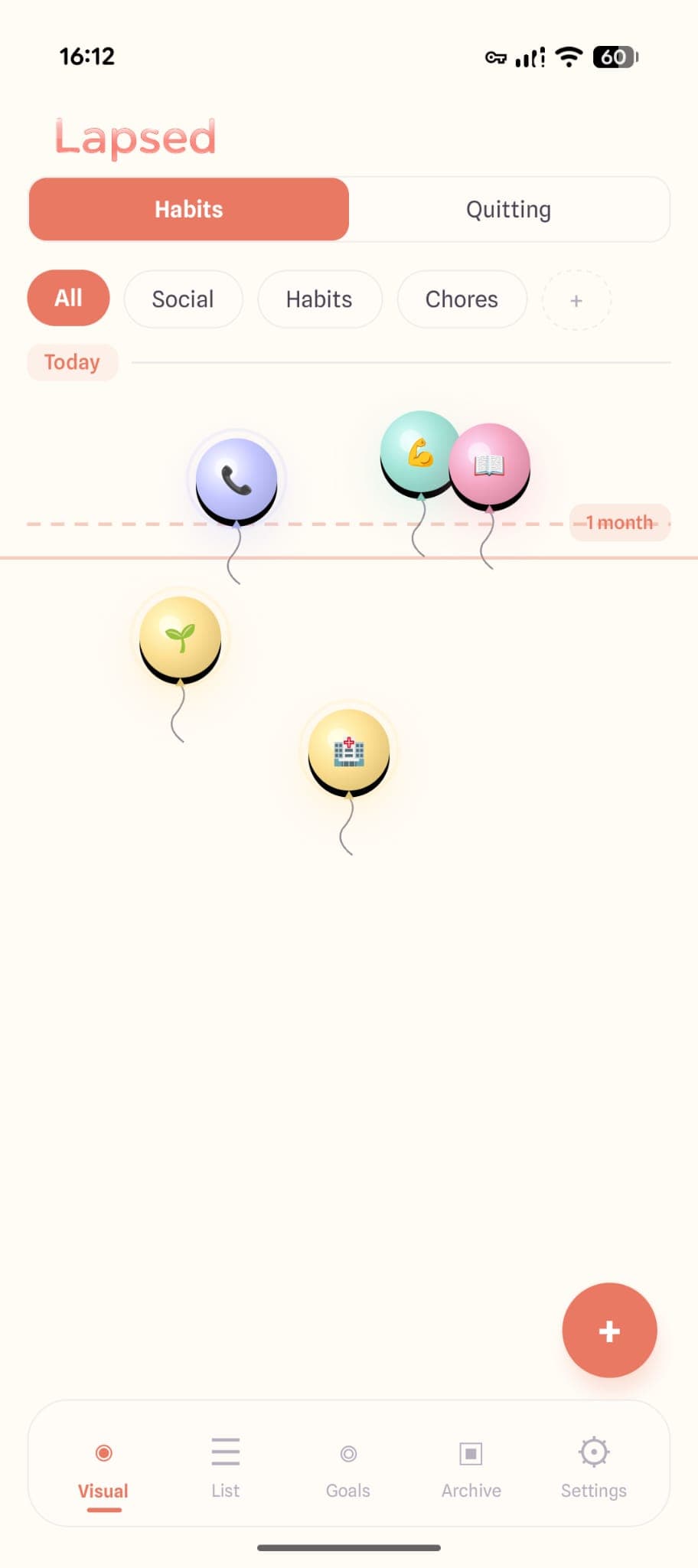
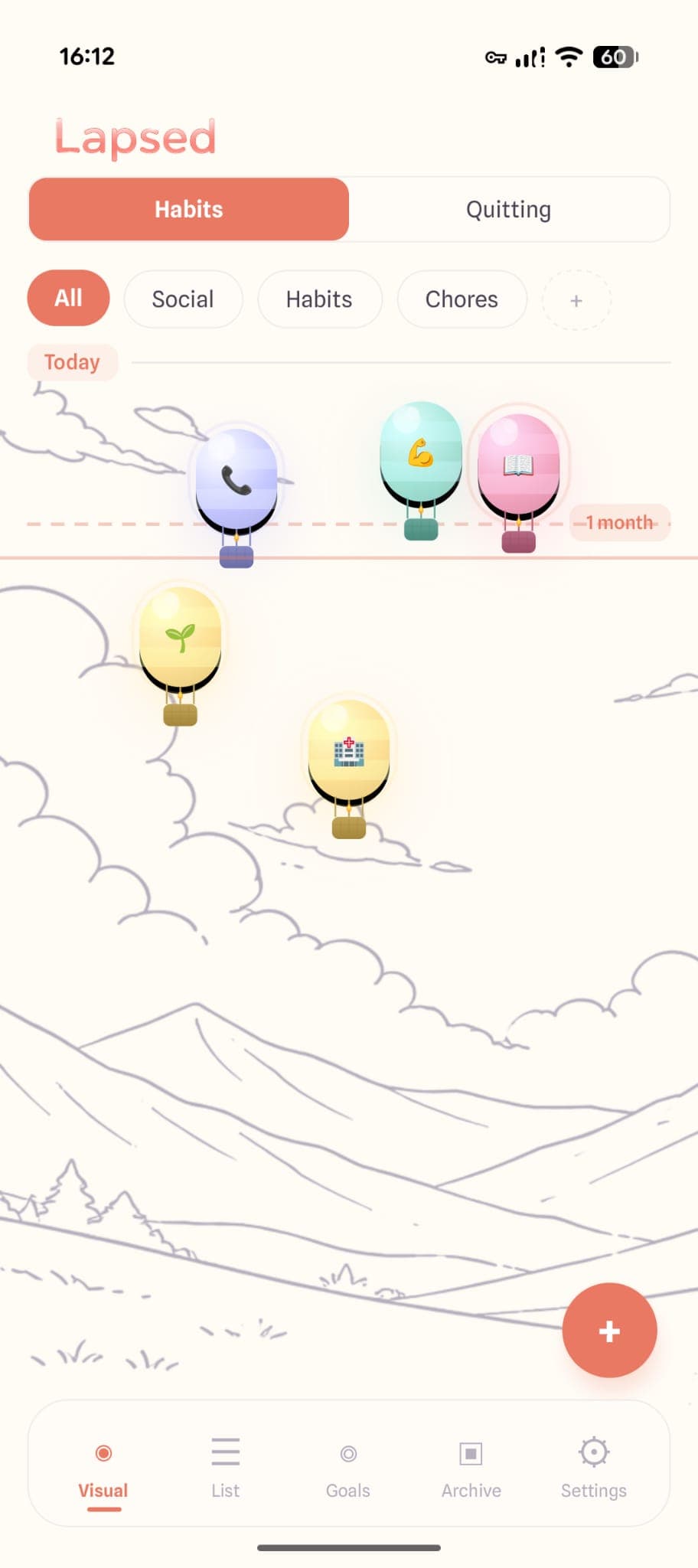
This is the approach Lapsed takes. Every item you track becomes a visual element — a dot, a balloon, or a hot air balloon — floating on a canvas. A threshold line marks your target. Items above the line need attention. Items below are fine. The entire state of your life is readable at a glance.
The Snap-Back Reward
There is a small moment of satisfaction when you log something in Lapsed and watch the dot snap back to today's line. It is a tiny visual reward — but it activates the same feedback loop that makes games compelling. You did the thing, you see the result immediately, you feel good. No waiting for a streak number to increment. No abstract "+1" notification. A visible, spatial change on your canvas.
The Design Problem No One Talks About
Here is something the habit tracker industry does not like to acknowledge: most habit trackers are ugly. Or at best, generic. Clean material design with checkboxes and progress bars. Functional, but emotionally flat.
This matters more than developers think. You open your habit tracker every day — ideally multiple times a day. If the experience of opening it generates no positive emotion, you will gradually stop doing it. Not because you lack discipline, but because your brain has no reason to prioritise it over the dozens of other apps competing for your attention.
Glassmorphism
Frosted glass cards with soft depth. Lapsed uses a design language that feels premium and calming — not clinical.
Colour Coding
Each category has its own colour. Periwinkle for social, mint for health, yellow for chores. Your canvas becomes a colourful map of your life.
Calm Animations
Gentle drifting, smooth transitions. Everything moves at a pace designed to feel peaceful, not urgent or gamified.
Three Visual Styles
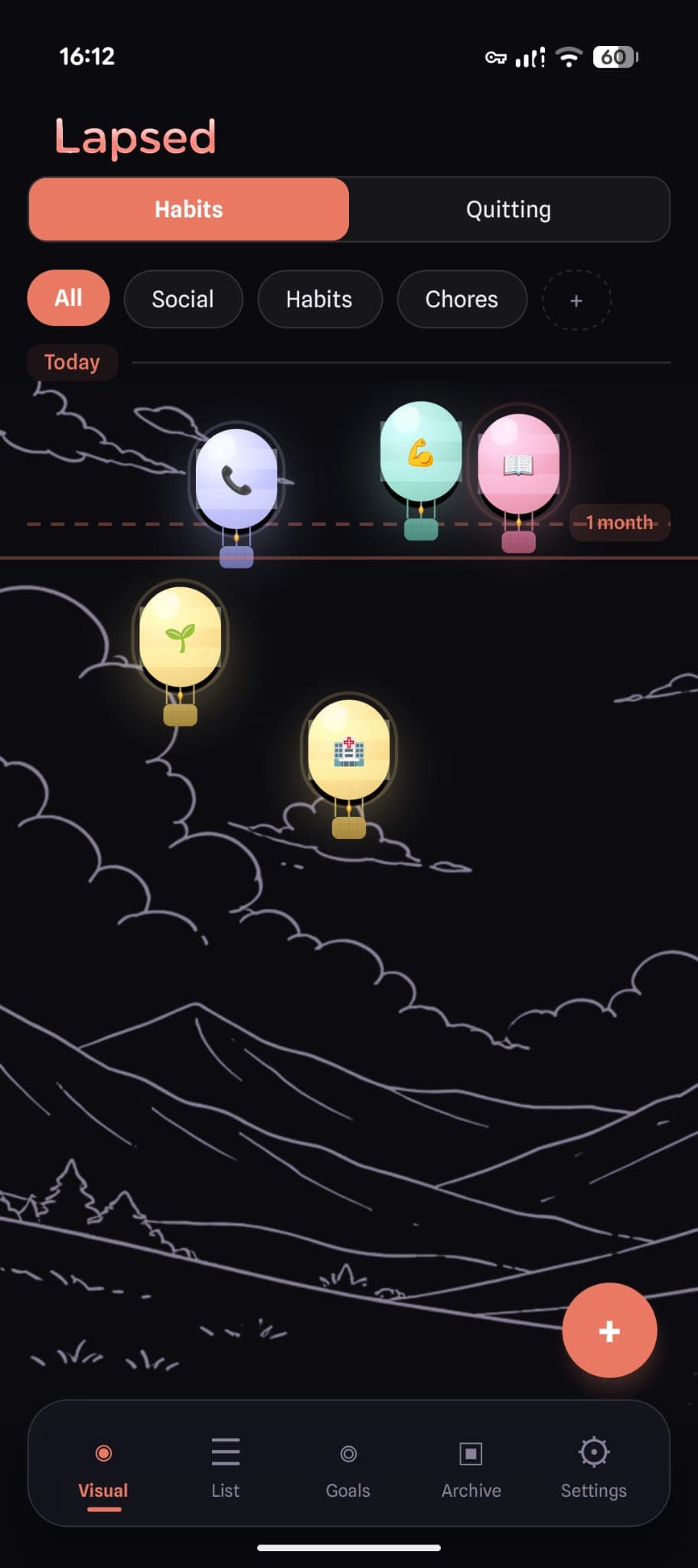
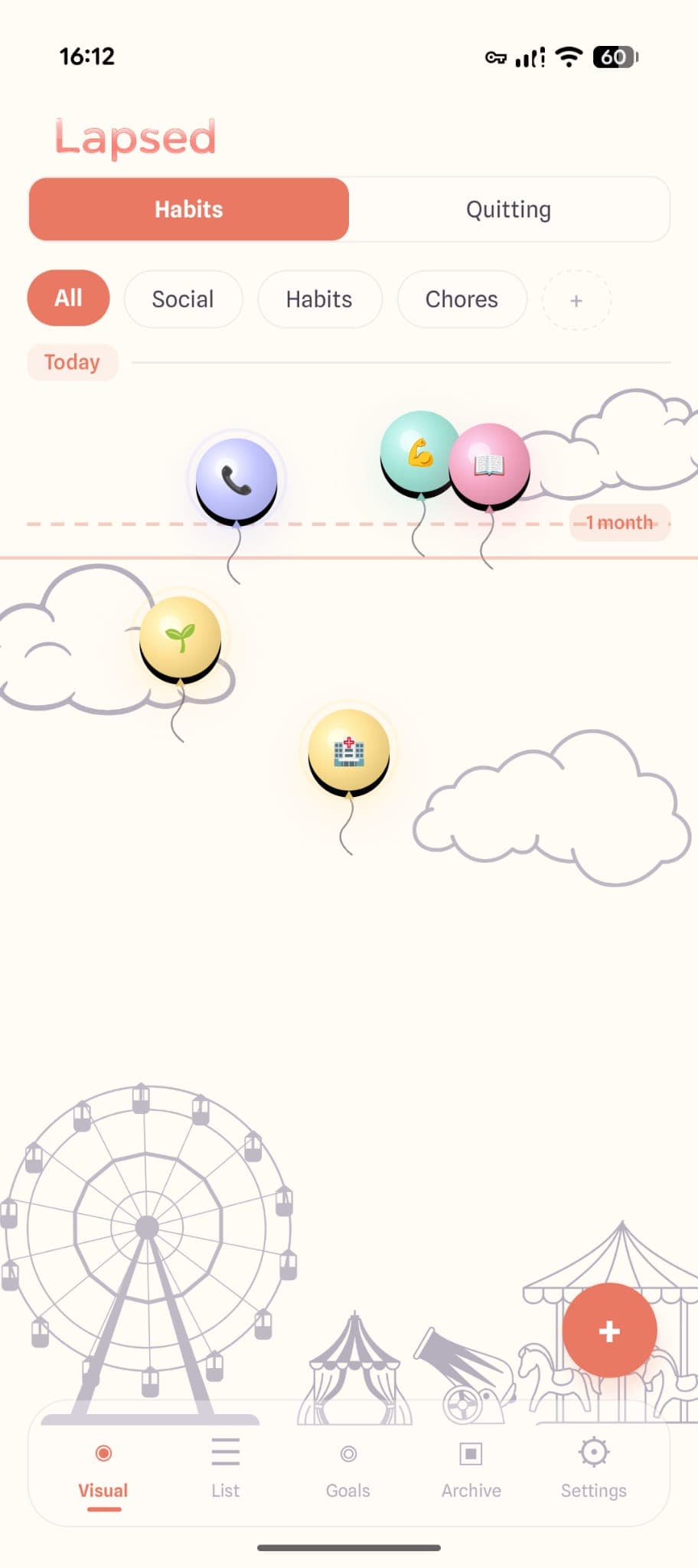
Dots, balloons, and hot air balloons. Choose the personality that matches your mood. Switch whenever you want.
Beauty is not a luxury feature in a habit tracker. It is the difference between an app you open daily and one that gathers dust on your second home screen.
What the Best Habit Trackers Get Right
Not everything about popular trackers is wrong. Here is what the best ones understand — and how a simpler approach builds on those insights:
Streaks understands that constraints help. Its 24-habit limit prevents overwhelm. A days-since tracker goes further: track just the things that genuinely matter, with flexible timing instead of rigid daily requirements.
Way of Life understands that colour communicates. Its green/yellow/red system gives instant feedback. A visual canvas takes this further by adding spatial position — you see both the colour (category) and the distance (elapsed time) simultaneously.
Loop Habit Tracker understands that privacy matters. Its offline-first approach means your data stays on your phone. A good simple tracker should do the same — your habits are personal.
(Not Boring) Habits understands that broken streaks are toxic. Its "saved progress" system tries to fix this. A threshold line goes further by removing the streak concept entirely — there is nothing to save because nothing breaks.
The pattern is clear: the best ideas in habit tracking all point toward simplicity, visual feedback, and flexible expectations. A days-since tracker with a visual canvas is where these ideas converge.
Trying a Simpler Approach
If you have cycled through Streaks, Habitica, Productive, and a dozen others — and none of them stuck — the problem might not be you. It might be the model.
A days-since tracker asks less of you. Open it once a day. See what is drifting. Tap things when you do them. There are no streaks to maintain, no chains to protect, no complex scheduling to configure. Just a canvas that shows you, visually, what needs attention.
Try something simpler
Lapsed is a days since tracker with a visual canvas. No streaks, no complexity, no guilt. Just clarity.
Read more about the power of visual tracking, or if you have ADHD, check out why visual, guilt-free tracking works for ADHD brains.
Simple tracking, beautiful design
Three items, one category, free forever. That is all you need to see if simple tracking works for you.
Written by Lapsed
The beautiful days since tracker. Track your life visually.
Related Articles
The Best Days Since Tracker Apps in 2026: An Honest Comparison
Looking for the best days since tracker or day counter app? We compare the top options — from sobriety counters to visual trackers — and explain what makes each one different.
Why Lapsed Is Different From Every Other Days Since Tracker
Most day counter apps are built for sobriety tracking. Lapsed is a days since tracker for everything in your life — with a design that makes time tracking beautiful and engaging.
Days Since Tracker vs Habit Tracker: Which Do You Actually Need?
The difference between a days since tracker and a habit tracker is more than semantics. One asks 'did you do it today?' while the other asks 'how long has it been?' Here is why most people need the latter.